Tuesday, April 17, 2012

Toshiba to buy IBM's point-of-sale terminal business: source

Toshiba A unit of Toshiba Corp (6502.T) is in talks to buy IBM Corp's (IBM.N) point-of-sale (POS) terminal business, which includes cash registers, a source familiar with the deal said on Tuesday.

The purchase, which local media put at around $870 million, was aimed at expanding the global reach of Toshiba's half-owned Toshiba Tec Corp (6588.T), making it the world's largest vendor of POS systems and equipment, the source told Reuters.

The company's board had yet to meet to finalize the deal, the source added.

Toshiba Tec shares gained 7.5 percent in Tokyo to 329 yen, outperforming a flat overall market.

Toshiba Tec would pay 70 billion yen ($870 million) for the IBM business - which counts Wal-Mart (WMT.N) and Toys "R" Us (TOYS.N) as customers - mainly financing the deal with cash reserves and bank loans, the Nikkei business daily reported.

IBM holds the top slot in the global POS terminal market with a share of 22 percent, the Nikkei said, compared with a 7 percent share for the Toshiba subsidiary.

IBM's technology would strengthen Toshiba's cloud computing services that enable stores, shoppers, manufacturers and others to exchange information and offer services, it said.

($1 = 80.3800 Japanese yen)

(Reporting by Maki Shiraki in TOKYO and Sagarika Jaisinghani in BANGALORE; editing by Sreejiraj Eluvangal and Richard Pullin)
Reuters

Sunday, April 15, 2012

Apple: Update will fix Mac 'Flashback' virus

white-plastic-13-inch-macbook-story-top Apple says a new software update provides tools to get rid of the so-called "Flashback" virus that has infected hundreds of thousands of Mac computers.

In a post on its support forums, Apple said the update to the Java software platform "removes the most common variants" of the Flashback malware.

Last week, a Russian security company reported that as many as 600,000 Macs, most of them in the United States and Canada, had been infected by Flashback, a Trojan horse virus that infiltrates computers, secretly giving someone else remote access to them.

Flashback was first discovered in September, disguising itself as an Adobe Flash Player installer.

Apple recommended the new update to all Mac users who have Java installed.

Throughout their history, Macs have been relatively free from most of the viruses and other malware that have targeted PCs, with cybercriminals preferring to go after the larger number of computer users on that system.

But the rise of Macs has also seen an uptick in the number of Mac users targeted.

"Malware authors have targeted the Mac OS for quite some time; however, the recent OSX.Flashback.K infections indicate a very significant shift to the current threat landscape, which is dominated by malware on the Windows operating system," Web security firm Symantec posted on its blog.

Symantec estimates that the number of computers still infected is down to about 270,000, slightly less than half of the number that was reported a week ago.

Apple, which prides itself on keeping a safe environment for users, was criticized in some quarters for the amount of time it took to respond to Flashback.

"Better late than never?" wrote Tony Bradley of PCWorld on Friday.

Bradley was more complimentary of the fix itself. While previous updates have closed the loophole that allowed the malware, the latest fixes the damage and is designed to protect Macs from similar attacks in the future.

"Kudos to Apple," he wrote. "It may be late to the game when it comes to helping users remove the Flashback malware from Mac OS X, but it has raised the bar for proactively protecting systems at the same time."

CNN

North Korea leader addresses nation for first time

North-Korea-008 North Korea's new leader addressed his nation and the world for the first time on on Sunday , vowing to prioritise his impoverished country's military, which promptly unveiled a new long-range missile.

The speech was the culmination of two weeks of celebrations marking the centenary of the birth of his grandfather, national founder Kim Il-sung – festivities that were marred by a failed launch on Friday of a rocket that generated international condemnation and cost North Korea a food aid-for-nuclear-freeze deal with Washington.

Kim Jong-un's speech took North Koreans gathered at Kim Il-sung Square and around televisions across the country by surprise. His father, late leader Kim Jong-il, addressed the public only once in his lifetime.

Appearing calm and measured as he read the 20-minute speech, Kim Jong-un covered a wide range of topics, from foreign policy to the economy. His speech, and a military parade that followed, capped the carefully choreographed festivities commemorating Kim Il-sung's birthday, which included a fireworks display.

It was the best look yet the outside world has had of the young Kim, who is believed to be in his late 20s.

Punctuating Kim's message that the North will continue to pour funds into its military, the parade culminated with the unveiling of a new long-range missile, though it is not clear how powerful or significant the addition to the North Korean arsenal is. Some analysts suggested it might have been a dummy designed to dupe outside observers.

Although the rocket launch on Friday was a huge, costly embarrassment for the new leadership, Kim's address was seen by analysts as an expression of confidence by the young leader and meant to show that he is firmly in control.

"Superiority in military technology is no longer monopolised by imperialists, and the era of enemies using atomic bombs to threaten and blackmail us is forever over," Kim said.

His message suggested no significant changes in national policy – the "Military First" strategy has long been at the centre of North Korea's decision-making process.

But there was strong symbolism in the images of the new leader addressing the country on state TV and then watching – and often laughing and gesturing in relaxed conversation with senior officials – as the cream of his nation's 1.2 million-strong military marched by.

Outside analysts have raised worries about how Kim, who has been seen but not publicly heard since taking over after his father's December death, would govern a country that has a nuclear weapons program and has previously threatened Seoul and Washington with war.

At the celebration of Kim Il-sung, he appeared to clear his first hurdle.

The speech was a good "first impression for his people and for the world," said Hajime Izumi, a North Korea expert at Japan's Shizuoka University. "He demonstrated that he can speak in public fairly well, and at this stage that in itself – more than what he actually said – is important. I think we might be seeing him speak in public more often, and show a different style than his father."

Kim said he will strengthen North Korea's defences by placing the country's "first, second and third" priorities on military might. But he said he is open to working with foreign countries that do not have hostile policies toward his nation, and said he would strive to reunify Korea.

He also stressed the importance of national unity, calling his country "Kim Il-sung's Korea" rather than North Korea.

"That suggests to me that they want to let the country, and the world, know that this is a 'new' country," said Han S. Park, a University of Georgia professor who works frequently with top US and North Korean officials, after watching the events in Pyongyang.

The Guardian

Chinese police seek blogger who revealed death of Neil Heywood

Neil-Heywood-008 The Chinese reporter who first revealed Neil Heywood's death on his microblog – apparently unaware of its alleged connection to the family of senior communist party leader Bo Xilai – has been sought by officials, he has revealed .

Chinese state media announced last week that Bo's wife, Gu Kailai, and a family employee were in custody on suspicion of murdering the Briton, who died in Chongqing last November.

Bo, then party secretary of the south-western city, has been suspended from key political roles and is under investigation for disciplinary violations.

Journalist Chu Chaoxin wrote on his microblog: "I don't deny that I posted the name of Neil Heywood first in March. Because of this, yesterday there were public people [presumably police] without licences who were trying to find me and harassed my friend and intended to take him to the police station with the excuse that he didn't have a temporary residency certificate [for the city]."

He added: "After negotiation and airing it on the microblog, police apologised. The truth proved that Neil Heywood is not a rumour. If they want to lock up people who told the truth, I am willing to be that person and make history."

The claims that Gu had killed Heywood first surfaced in a series of microblog posts in March, citing a mystery text message received by the journalist.

Chu could not be reached for comment, but people with knowledge of the incident said the message – from an unknown number – said only that Heywood had been killed and did not give further details or mention either Bo or Gu. They said Chu's post about the death was deleted and it is not clear how the allegations about Gu's involvement surfaced weeks later.

The UK first announced that it had asked China to reinvestigate the case in March. Bo's former ally and police chief, Wang Lijun, is believed to have told US officials of his suspicions about the death when he fled to the US consulate in Chengdu in February. He is now under investigation by Chinese authorities.

Prior to news of Gu's detention, Heywood's family said that the 41-year-old died of a heart attack.

British consular officials in China expressed suspicion about the death but no action was taken because other officials thought asking Chinese authorities to investigate would be problematic, the Wall Street Journal reported.

It cited unspecified sources who added that some British officials knew local police had pressured Heywood's Chinese wife to agree to a swift cremation without an autopsy. Police have warned Lulu Wang not to speak to foreign media, Reuters reported .

Chinese state media has sought to play down the scandal, which comes months before power is transferred to a new generation of leaders. A commentary in the Global Times argued: "Bo's case is an independent incident of a violation of party discipline and China's laws. What's going on is the inevitable result of a lawful investigation. It is an exaggeration to say the case mirrors China's 'political fight'."

The Guardian

Saturday, April 14, 2012

Ashton: Iran nuclear talks 'constructive and useful'

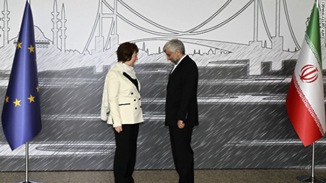
iran-jalili-ashton-story-top After months of tension and frustration, key world powers and Iran sounded more optimistic Saturday after "constructive and useful" talks about Tehran's intentions for its nuclear program.

"We have agreed that the nonproliferation treaty forms a key basis for what must be serious engagement to ensure all the obligations under the treaty are met by Iran while fully respecting Iran's right to the peaceful use of nuclear energy," EU foreign policy chief Catherine Ashton said following the meeting with Iran's top negotiator, Saeed Jalili.

Ashton said Saturday's meeting in Istanbul was a basis to establish a "sustained process of serious dialogue."

The next meeting between Jalili and delegates from the five permanent members of the United Nations Security Council -- the United States, France, Russia, China, and Britain -- and Germany, will be held May 23 in Baghdad.

Jalili insisted that the goal of his nation's nuclear program is to produce energy, not weaponry. He stressed, too, that Iran "should enjoy our rights" to have nuclear energy.

That said, Jalili also noted the "positive approach" of the recent talks, saying they furthered the "process of cooperation."

Ashton and Jalili said that experts will meet before May 23 to create a detailed framework for future discussions about Iran's program.

"We expect that subsequent meetings will lead to concrete steps toward a comprehensive negotiated solution which restores international confidence in the exclusively peaceful nature of the Iranian nuclear program," Ashton told reporters.

The group of delegates -- also known as the P5+1 -- has spearheaded diplomatic efforts to persuade Iran to rein in its nuclear program, which Iran has said is purely peaceful. U.N. and Western leaders suspect it of having military aims, including a possible nuclear weapon.

All sides agreed to postpone talks about the details of Iran's nuclear program to a later date.

Ashton said that future dialogue would involve the principle of a "step-by-step approach and reciprocity."

Asked specifically what she meant, Ashton told CNN the steps "will be designed to build the confidence that there isn't going to be a nuclear weapons program. That might be, for example, enabling inspectors to have more access."

Reciprocity, Ashton indicated, could include rewarding Iran, which is under significant global sanctions, if it dismantles inappropriate programs.

"But that needs to be very carefully thought about," she said. "And it is very important that we recognize the importance of sanctions in taking and actually getting us to today."

Iran last met with the six powers for talks on its nuclear program 15 months ago. That meeting, also in Istanbul, was widely regarded as ending in failure when Iran presented what the international side said were preconditions for talks.

Jalili told CNN later Saturday said his country has supported positive dialogue.

"We have always said confidence building has been a two-way street," he said.

Going into Saturday's meeting, the indications from behind the scenes were that both sides wanted to make progress.

Ashton said the P5+1 wanted to know whether Iran was serious toward moving toward a sustained process.

Apparently, the group was satisfied by Iran's rhetoric.

Iranian Foreign Minister Ali Akbar Salehi said in an opinion piece published Friday in the Washington Post that Tehran is committed to a peaceful program, but it needs to see trust from the international side.

"Despite sanctions, threats of war, assassinations of several of our scientists and other forms of terrorism, we have chosen to remain committed to dialogue," he wrote.

"In the upcoming talks, we hope that all sides will return to the negotiating table as equals with mutual respect; that all sides will be committed to comprehensive, long-term dialogue aimed at resolving all parties' outstanding concerns; and, most important, that all sides make genuine efforts to reestablish confidence and trust."

Iran has been under increasing pressure to accept international demands to restrict its nuclear program, including a series of harsh economic sanctions imposed by European nations and the United States. It hopes future negotiations will lead to an end to those sanctions.

Last month, Iranian officials signaled that they were ready to engage with the International Atomic Energy Agency, the U.N. nuclear watchdog, over the issue.

Iran suggested last week that one proposal may be a reduction in the amount of uranium it enriches to 20%, but it was unclear if such a proposal was still on the table.

While the enrichment isn't enough to create nuclear weapons, which require a uranium content of 90% or more, analysts and inspectors say it is a step toward being able to create a nuclear weapon.

Last month, the IAEA noted what it called a sharp and troubling increase in Iran's uranium enrichment capabilities.

Iran says the enrichment is for research and medical needs.

As a signatory to the Nuclear Nonproliferation Treaty, Iran has the right, like other countries, to enrich uranium for commercial and research reactors. But the same facilities that are used for peaceful enrichment can be used to enrich uranium for a bomb, and inspectors say they have not been able to fully gauge Iran's intentions.

CNN

 
News Update Users